what does it mean to get g noted
Prove Mobile Find Show All NotesHide All Notes
Mobile Detect
You appear to be on a device with a "narrow" screen width (i.e. you are probably on a mobile phone). Due to the nature of the mathematics on this site information technology is all-time views in landscape mode. If your device is not in mural mode many of the equations will run off the side of your device (should be able to roll to see them) and some of the carte du jour items will be cut off due to the narrow screen width.
Section ii-5 : Computing Limits
In the previous section nosotros saw that there is a large class of functions that allows united states of america to apply
\[\mathop {\lim }\limits_{ten \to a} f\left( x \right) = f\left( a \right)\]
to compute limits. However, there are too many limits for which this won't piece of work easily. The purpose of this section is to develop techniques for dealing with some of these limits that volition not let u.s. to merely use this fact.
Permit'southward first become back and accept a look at one of the kickoff limits that we looked at and compute its exact value and verify our guess for the limit.
Case 1 Evaluate the following limit. \[\mathop {\lim }\limits_{x \to 2} \frac{{{x^2} + 4x - 12}}{{{x^2} - 2x}}\]
Show Solution
First let'due south notice that if nosotros try to plug in \(x = 2\) nosotros get,
\[\mathop {\lim }\limits_{ten \to ii} \frac{{{x^2} + 4x - 12}}{{{x^2} - 2x}} = \frac{0}{0}\]
Then, we can't just plug in \(x = ii\) to evaluate the limit. So, we're going to accept to do something else.
The first thing that we should always practice when evaluating limits is to simplify the function as much as possible. In this case that ways factoring both the numerator and denominator. Doing this gives,
\[\begin{marshal*}\mathop {\lim }\limits_{10 \to 2} \frac{{{10^2} + 4x - 12}}{{{x^two} - 2x}} & = \mathop {\lim }\limits_{x \to two} \frac{{\left( {10 - 2} \correct)\left( {x + six} \correct)}}{{x\left( {x - two} \right)}}\\ & = \mathop {\lim }\limits_{x \to ii} \frac{{10 + 6}}{ten}\end{align*}\]
Then, upon factoring we saw that nosotros could cancel an \(x - 2\) from both the numerator and the denominator. Upon doing this we now have a new rational expression that nosotros tin can plug \(x = 2\) into considering we lost the division by aught problem. Therefore, the limit is,
\[\mathop {\lim }\limits_{x \to 2} \frac{{{x^2} + 4x - 12}}{{{x^2} - 2x}} = \mathop {\lim }\limits_{x \to 2} \frac{{10 + 6}}{10} = \frac{eight}{2} = iv\]
Note that this is in fact what we guessed the limit to be.
Before leaving this example let's discuss the fact that nosotros couldn't plug \(x = 2\) into our original limit but once we did the simplification we just plugged in \(10 = 2\) to get the answer. At starting time glance this may appear to be a contradiction.
In the original limit we couldn't plug in \(x = two\) because that gave us the 0/0 situation that we couldn't exercise anything with. Upon doing the simplification we tin can notation that,
\[\frac{{{10^2} + 4x - 12}}{{{x^two} - 2x}} = \frac{{x + six}}{x}\hspace{0.25in}{\mbox{provided }}x \ne 2\]
In other words, the 2 equations give identical values except at \(x = ii\) and because limits are only concerned with that is going on around the point \(x = 2\) the limit of the two equations will be equal. More importantly, in the simplified version we get a "nice enough" equation and then what is happening around \(x = 2\) is identical to what is happening at \(x = 2\).
Nosotros can therefore take the limit of the simplified version only by plugging in \(x = 2\) fifty-fifty though we couldn't plug \(x = ii\) into the original equation and the value of the limit of the simplified equation will exist the same equally the limit of the original equation.
On a side note, the 0/0 nosotros initially got in the previous case is called an indeterminate form. This means that nosotros don't really know what it will be until we do some more piece of work. Typically, zilch in the denominator means it'due south undefined. However, that will only exist true if the numerator isn't besides zero. Likewise, zero in the numerator usually ways that the fraction is cypher, unless the denominator is also zero. Likewise, anything divided by itself is 1, unless we're talking about cypher.
So, at that place are really three competing "rules" here and it'southward not clear which one will win out. It'southward also possible that none of them will win out and nosotros will get something totally different from undefined, zero, or one. We might, for case, go a value of 4 out of this, to pick a number completely at random.
When simply evaluating an equation 0/0 is undefined. Still, in taking the limit, if we become 0/0 we tin go a diversity of answers and the only fashion to know which on is right is to really compute the limit.
There are many more kinds of indeterminate forms and nosotros will exist discussing indeterminate forms at length in the side by side affiliate.
Permit'south take a wait at a couple of more examples.
Example 2 Evaluate the following limit. \[\mathop {\lim }\limits_{h \to 0} \frac{{2{{\left( { - 3 + h} \correct)}^two} - 18}}{h}\]
Show Solution
In this case we also get 0/0 and factoring is not actually an option. Nevertheless, there is even so some simplification that we can practise.
\[\begin{align*}\mathop {\lim }\limits_{h \to 0} \frac{{2{{\left( { - 3 + h} \right)}^2} - 18}}{h} & = \mathop {\lim }\limits_{h \to 0} \frac{{2\left( {9 - 6h + {h^2}} \right) - 18}}{h}\\ & = \mathop {\lim }\limits_{h \to 0} \frac{{18 - 12h + 2{h^2} - xviii}}{h}\\ & = \mathop {\lim }\limits_{h \to 0} \frac{{ - 12h + ii{h^2}}}{h}\terminate{marshal*}\]
So, upon multiplying out the first term we get a little cancellation and now notice that nosotros can cistron an \(h\) out of both terms in the numerator which volition abolish against the \(h\) in the denominator and the sectionalisation by zero problem goes away and we can and so evaluate the limit.
\[\begin{align*}\mathop {\lim }\limits_{h \to 0} \frac{{2{{\left( { - three + h} \right)}^2} - xviii}}{h} & = \mathop {\lim }\limits_{h \to 0} \frac{{ - 12h + 2{h^2}}}{h}\\ & = \mathop {\lim }\limits_{h \to 0} \frac{{h\left( { - 12 + 2h} \right)}}{h}\\ & = \mathop {\lim }\limits_{h \to 0} \,\, - 12 + 2h = - 12\stop{align*}\]
Instance 3 Evaluate the following limit. \[\mathop {\lim }\limits_{t \to iv} \frac{{t - \sqrt {3t + 4} }}{{4 - t}}\]
Show Solution
This limit is going to exist a little more work than the previous two. Once again however note that we get the indeterminate course 0/0 if we attempt to but evaluate the limit. Also note that neither of the ii examples volition be of any help here, at least initially. Nosotros can't factor the equation and we can't only multiply something out to go the equation to simplify.
When there is a foursquare root in the numerator or denominator we can effort to rationalize and see if that helps. Recall that rationalizing makes use of the fact that
\[\left( {a + b} \correct)\left( {a - b} \right) = {a^2} - {b^two}\]
And then, if either the first and/or the 2d term accept a foursquare root in them the rationalizing will eliminate the root(s). This might help in evaluating the limit.
Let'southward endeavor rationalizing the numerator in this instance.
\[\mathop {\lim }\limits_{t \to 4} \frac{{t - \sqrt {3t + 4} }}{{4 - t}} = \mathop {\lim }\limits_{t \to 4} \frac{{\left( {t - \sqrt {3t + 4} } \right)}}{{\left( {four - t} \correct)}}\,\frac{{\left( {t + \sqrt {3t + 4} } \right)}}{{\left( {t + \sqrt {3t + 4} } \correct)}}\]
Call up that to rationalize we just accept the numerator (since that'south what we're rationalizing), alter the sign on the second term and multiply the numerator and denominator by this new term.
Next, we multiply the numerator out being careful to sentry minus signs.
\[\begin{marshal*}\mathop {\lim }\limits_{t \to four} \frac{{t - \sqrt {3t + 4} }}{{4 - t}} & = \mathop {\lim }\limits_{t \to 4} \frac{{{t^two} - \left( {3t + 4} \correct)}}{{\left( {4 - t} \right)\left( {t + \sqrt {3t + 4} } \right)}}\\ & = \mathop {\lim }\limits_{t \to iv} \frac{{{t^two} - 3t - 4}}{{\left( {4 - t} \right)\left( {t + \sqrt {3t + four} } \right)}}\terminate{align*}\]
Find that we didn't multiply the denominator out every bit well. Most students come up out of an Algebra class having it beaten into their heads to always multiply this stuff out. However, in this case multiplying out volition make the problem very difficult and in the end you'll only end up factoring information technology back out anyway.
At this stage we are almost done. Detect that we tin can gene the numerator so allow's do that.
\[\mathop {\lim }\limits_{t \to iv} \frac{{t - \sqrt {3t + 4} }}{{four - t}} = \mathop {\lim }\limits_{t \to 4} \frac{{\left( {t - 4} \right)\left( {t + 1} \right)}}{{\left( {four - t} \right)\left( {t + \sqrt {3t + iv} } \right)}}\]
Now all nosotros need to practise is notice that if nosotros gene a "-1"out of the first term in the denominator we can practise some canceling. At that point the division by goose egg problem will go away and nosotros can evaluate the limit.
\[\brainstorm{align*}\mathop {\lim }\limits_{t \to iv} \frac{{t - \sqrt {3t + iv} }}{{4 - t}} & = \mathop {\lim }\limits_{t \to 4} \frac{{\left( {t - four} \right)\left( {t + ane} \right)}}{{ - \left( {t - 4} \correct)\left( {t + \sqrt {3t + 4} } \correct)}}\\ & = \mathop {\lim }\limits_{t \to 4} \frac{{t + one}}{{ - \left( {t + \sqrt {3t + 4} } \right)}}\\ & = - \frac{5}{viii}\end{align*}\]
Notation that if we had multiplied the denominator out we would not have been able to do this canceling and in all likelihood would not take fifty-fifty seen that some canceling could have been done.
So, we've taken a look at a couple of limits in which evaluation gave the indeterminate course 0/0 and we now have a couple of things to try in these cases.
Let's take a look at another kind of trouble that can arise in computing some limits involving piecewise functions.
Example four Given the function, \[g\left( y \right) = \left\{ \begin{align*}{y^ii} + 5 & \hspace{0.25in}{\mbox{if }}y < - 2\\ 1 - 3y & \hspace{0.25in}{\mbox{if }}y \ge - 2\end{marshal*} \right.\]
Compute the following limits.
- \(\mathop {\lim }\limits_{y \to half dozen} g\left( y \correct)\)
- \(\mathop {\lim }\limits_{y \to - 2} thou\left( y \correct)\)
Bear witness All SolutionsHide All Solutions
a \(\mathop {\lim }\limits_{y \to 6} g\left( y \right)\) Show Solution
In this example at that place actually isn't a whole lot to practice. In doing limits recall that we must e'er look at what's happening on both sides of the point in question as nosotros move in towards it. In this case \(y = 6\) is completely inside the 2nd interval for the function then there are values of \(y\) on both sides of \(y = half-dozen\) that are also within this interval. This means that we can just use the fact to evaluate this limit.
\[\brainstorm{align*}\mathop {\lim }\limits_{y \to half dozen} yard\left( y \correct) & = \mathop {\lim }\limits_{y \to vi}( 1 - 3y)\\ & = - 17\end{align*}\]
b \(\mathop {\lim }\limits_{y \to - two} thousand\left( y \right)\) Prove Solution
This part is the real signal to this problem. In this case the betoken that we want to take the limit for is the cutoff indicate for the two intervals. In other words, we can't only plug \(y = - ii\) into the second portion because this interval does non incorporate values of \(y\) to the left of \(y = - 2\) and nosotros need to know what is happening on both sides of the point.
To practise this part nosotros are going to have to remember the fact from the section on one-sided limits that says that if the two one-sided limits exist and are the aforementioned and so the normal limit volition likewise exist and accept the same value.
Find that both of the one-sided limits can be done here since we are only going to be looking at one side of the point in question. So, let's do the ii one-sided limits and see what we get.
\[\begin{align*}\mathop {\lim }\limits_{y \to - {ii^ - }} 1000\left( y \right) & = \mathop {\lim }\limits_{y \to - {2^ - }} ({y^2} + 5)\hspace{0.25in}{\mbox{since }}y \to {-2^ - }{\mbox{ implies }}y < - 2\\ & = ix\finish{align*}\] \[\begin{align*}\mathop {\lim }\limits_{y \to - {two^ + }} g\left( y \right) & = \mathop {\lim }\limits_{y \to - {2^ + }} (ane - 3y)\hspace{0.25in}{\mbox{since }}y \to {-two^ + }{\mbox{ implies }}y > - 2\\ & = 7\end{align*}\]
And so, in this instance nosotros tin encounter that,
\[\mathop {\lim }\limits_{y \to - {2^ - }} g\left( y \right) = 9 \ne 7 = \mathop {\lim }\limits_{y \to - {2^ + }} g\left( y \right)\]
and so since the ii one sided limits aren't the same
\[\mathop {\lim }\limits_{y \to - 2} g\left( y \right)\]
doesn't exist.
Note that a very unproblematic change to the part will make the limit at \(y = - 2\) exist so don't get in into your head that limits at these cutoff points in piecewise function don't ever exist as the following case will bear witness.
Instance 5 Evaluate the following limit. \[\mathop {\lim }\limits_{y \to - ii} one thousand\left( y \right)\hspace{0.25in}{\mbox{where,}}\,\,yard\left( y \correct) = \left\{ \begin{align*}{y^2} + 5 & \hspace{0.25in}{\mbox{if }}y < - ii\\ 3 - 3y & \hspace{0.25in}{\mbox{if }}y \ge - 2\finish{align*} \right.\]
Show Solution
The two ane-sided limits this fourth dimension are,
\[\begin{align*}\mathop {\lim }\limits_{y \to - {2^ - }} g\left( y \right) & = \mathop {\lim }\limits_{y \to - {2^ - }} ({y^2} + 5)\hspace{0.25in}{\mbox{since }}y \to {-2^ - }{\mbox{ implies }}y < - 2\\ & = 9\end{align*}\] \[\begin{align*}\mathop {\lim }\limits_{y \to - {2^ + }} m\left( y \right) & = \mathop {\lim }\limits_{y \to - {2^ + }} (three - 3y)\hspace{0.25in}{\mbox{since }}y \to {-two^ + }{\mbox{ implies }}y > - 2\\ & = 9\finish{align*}\]
The 1-sided limits are the aforementioned and then we get,
\[\mathop {\lim }\limits_{y \to - 2} g\left( y \correct) = 9\]
In that location is one more than limit that we need to practise. However, nosotros will need a new fact about limits that will help us to do this.
Fact
If \(f\left( x \right) \le g\left( ten \correct)\) for all \(10\) on \([a, b]\) (except possibly at \(x = c\)) and \(a \le c \le b\) then,
\[\mathop {\lim }\limits_{ten \to c} f\left( x \right) \le \mathop {\lim }\limits_{x \to c} chiliad\left( ten \right)\]
Note that this fact should make some sense to you if we assume that both functions are prissy enough. If both of the functions are "dainty enough" to use the limit evaluation fact then we accept,
\[\mathop {\lim }\limits_{x \to c} f\left( 10 \right) = f\left( c \right) \le g\left( c \right) = \mathop {\lim }\limits_{ten \to c} g\left( 10 \right)\]
The inequality is true because nosotros know that \(c\) is somewhere betwixt \(a\) and \(b\) and in that range nosotros too know \(f\left( x \right) \le g\left( x \right)\).
Note that we don't really need the two functions to be nice enough for the fact to be true, but it does provide a squeamish mode to give a quick "justification" for the fact.
Likewise, note that we said that we assumed that \(f\left( x \right) \le one thousand\left( x \right)\) for all \(x\) on \([a, b]\) (except possibly at \(x = c\)). Because limits do not intendance what is actually happening at \(x = c\) we don't really need the inequality to hold at that specific bespeak. We but need information technology to hold around \(x = c\) since that is what the limit is concerned about.
We can have this fact one step further to become the following theorem.
Squeeze Theorem
Suppose that for all \(x\) on \([a, b]\) (except possibly at \(x = c\)) nosotros have,
\[f\left( x \right) \le h\left( x \right) \le yard\left( 10 \right)\]
Also suppose that,
\[\mathop {\lim }\limits_{10 \to c} f\left( ten \right) = \mathop {\lim }\limits_{10 \to c} g\left( x \right) = L\]
for some \(a \le c \le b\). Then,
\[\mathop {\lim }\limits_{x \to c} h\left( ten \correct) = L\]
As with the previous fact we only need to know that \(f\left( x \right) \le h\left( 10 \correct) \le g\left( x \right)\) is true around \(x = c\) considering nosotros are working with limits and they are only concerned with what is going on effectually \(x = c\) and non what is really happening at \(x = c\).
Now, if we again presume that all three functions are prissy enough (again this isn't required to make the Clasp Theorem true, it just helps with the visualization) and then we can become a quick sketch of what the Squeeze Theorem is telling u.s.a.. The following figure illustrates what is happening in this theorem.
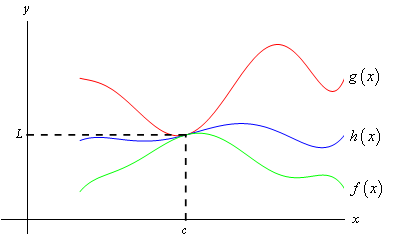
From the figure we can see that if the limits of \(f(x)\) and \(g(x)\) are equal at \(x = c\) and then the part values must likewise exist equal at \(x = c\) (this is where nosotros're using the fact that we assumed the functions where "overnice enough", which isn't actually required for the Theorem). However, because \(h(x)\) is "squeezed" betwixt \(f(x)\) and \(g(x)\) at this point and so \(h(x)\) must have the same value. Therefore, the limit of \(h(x)\) at this bespeak must likewise be the same.
The Squeeze theorem is also known as the Sandwich Theorem and the Pinching Theorem.
So, how practice we use this theorem to assist us with limits? Let'due south have a look at the following example to see the theorem in action.
Example 6 Evaluate the post-obit limit. \[\mathop {\lim }\limits_{x \to 0} {10^2}\cos \left( {\frac{one}{x}} \right)\]
Testify Solution
In this instance none of the previous examples can assist us. There'south no factoring or simplifying to do. We can't rationalize and one-sided limits won't work. There'due south even a question as to whether this limit will exist since we accept division by aught within the cosine at \(ten=0\).
The start thing to detect is that nosotros know the post-obit fact about cosine.
\[ - 1 \le \cos \left( 10 \right) \le ane\]
Our function doesn't accept but an \(x\) in the cosine, but as long as we avert \(x = 0\) we tin say the same affair for our cosine.
\[ - 1 \le \cos \left( {\frac{1}{x}} \right) \le i\]
It'southward okay for us to ignore \(x = 0\) here considering we are taking a limit and we know that limits don't care most what's really going on at the bespeak in question, \(x = 0\) in this case.
Now if nosotros have the above inequality for our cosine we can just multiply everything past an \(x^{2}\) and get the post-obit.
\[ - {x^two} \le {x^two}\cos \left( {\frac{1}{x}} \right) \le {x^2}\]
In other words we've managed to clasp the function that we were interested in between 2 other functions that are very easy to deal with. So, the limits of the ii outer functions are.
\[\mathop {\lim }\limits_{10 \to 0} {x^2} = 0\hspace{0.25in}\hspace{0.25in}\mathop {\lim }\limits_{x \to 0} \left( { - {x^2}} \right) = 0\]
These are the same and then past the Clasp theorem nosotros must also have,
\[\mathop {\lim }\limits_{x \to 0} {x^2}\cos \left( {\frac{1}{10}} \right) = 0\]
We tin verify this with the graph of the iii functions. This is shown below.
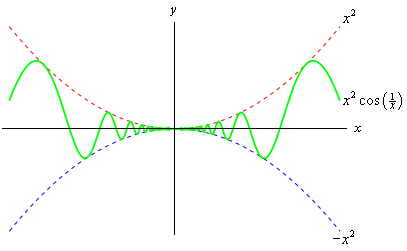
In this section we've seen several tools that nosotros tin can utilize to help united states to compute limits in which we can't simply evaluate the role at the indicate in question. As we will see many of the limits that we'll be doing in afterward sections will crave one or more than of these tools.
Source: https://tutorial.math.lamar.edu/Classes/CalcI/ComputingLimits.aspx
0 Response to "what does it mean to get g noted"
Post a Comment